
Dorchester County Arrest Records
Dorchester County arrest records relate to the arrest event: the agency involved, the person taken into custody, booking or intake activity, and custody status when that information is available. The research file confirms a Dorchester County Sheriff's Office website and an inmate-search route, but the site is a JavaScript app and the static HTML did not expose search fields. The official sheriff site also exposes mobile app metadata for the Dorchester County Sheriff's Office app.
Court charge records are different. After an arrest or charging event, the charge record reflects the alleged offense filed into the court process. It may include the charge description, statute, statement of charges, complainant or arresting agency, commissioner event, case number, bond status, and first court date. The full criminal case file, including pleas, motions, disposition, and sentence, belongs on the Dorchester County criminal court records path rather than in a jail or booking search.
Find Dorchester Arrest Charges
There is no confirmed Dorchester-only online arrest-record database in the research file. For custody status, the official sheriff route is Dorchester Sheriff inmate search, but the route requires JavaScript and the fields were not visible in static inspection. For court charges after arrest, use Maryland court case search channels and confirm whether the case is in District Court or Circuit Court.
- Check the sheriff's inmate-search route or official Dorchester County Sheriff's Office app for custody-related information when a person may be in local custody.
- Search the statewide court case system by defendant name or case number for court charges after arrest.
- Confirm Dorchester County and identify whether the charge is in District Court or Circuit Court.
- Read each charge separately, including statute, count, status, bond event, hearing date, and disposition if listed.
- Request certified copies from the court custodian when the charge record must be used as official proof.
An arrest record does not prove guilt. A person can be arrested and later released, charged later, not charged, or have charges dismissed. A person can also have active charges without being in jail. For that reason, custody tools and court-charge tools answer different questions.
Court Charges After Arrest
Maryland criminal court records can show several types of charging events. A statement of charges is commonly used at the initial stage in Maryland District Court. An information is filed by the prosecutor. An indictment is returned by a grand jury and is common in serious Circuit Court felony matters. A single arrest can produce more than one charge, and later court activity can change the charge list.
| Document | Who Starts It | Where It Often Appears | What It Means |
|---|---|---|---|
| Statement of charges | Officer, complainant, or commissioner process | Often District Court at the first stage | Initial charging document that can start the court case or hearing path. |
| Information | State's Attorney | Often Circuit Court criminal prosecution | Prosecutor-filed charging document that sets out formal counts. |
| Indictment | Grand jury | Serious felony or Circuit Court matters | Formal felony charging document returned through grand jury process. |
The Maryland State Archives Dorchester judicial branch page is one source for local court structure. The Dorchester judicial branch source helps place charge records in the local court system.
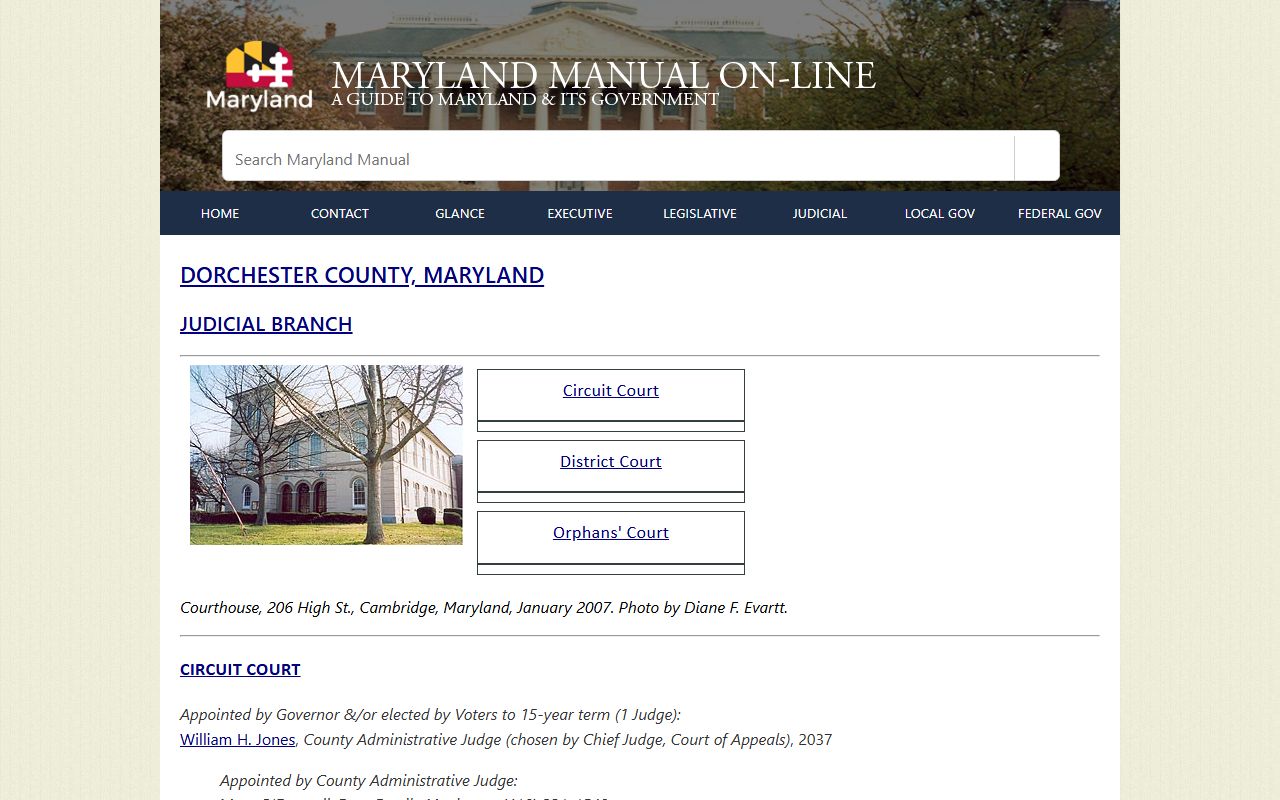
That structure matters because early District Court charge events can later connect to Circuit Court criminal prosecution.
Dorchester Charge Status
Charge status can change as the case moves. A pending charge is still open. An amended or reduced charge may replace or alter an earlier count. A dismissal may end a charge without a conviction. A nolle prosequi entry means the State declines to prosecute that charge at that time. A stet entry can place a case on an inactive docket under Maryland procedure. The exact public label should be read from the court docket.
| Status | What It Means |
|---|---|
| Pending | The charge is active and no final disposition has been entered for that count. |
| Amended or reduced | The charge was changed, replaced, or reduced as the prosecution or court process developed. |
| Dismissed | The charge ended without a conviction on that count, subject to the exact docket wording. |
| Nolle prosequi | The State declined to prosecute the charge at that point in the case. |
| Stet | The case or charge was placed on an inactive docket under Maryland procedure. |
| Guilty or not guilty | The count reached a plea or trial result, which must be read with the sentence and disposition entries. |
Charge vs Conviction
A charge is an accusation. A conviction is a court result. Dorchester County arrest records and court charge records can show allegations that never become convictions. This distinction is central when reading court charges after arrest, because a docket may list multiple counts with different outcomes. One count can be dismissed while another is amended, reduced, or resolved by plea.
| Charge | Conviction | |
|---|---|---|
| Timing | Appears when an alleged offense is filed or recorded. | Appears after a guilty plea, verdict, or qualifying court finding. |
| Proof | Based on accusation, probable cause, or charging process. | Based on final court outcome for the count. |
| Record use | Useful for tracking the case and current allegation. | Used to understand final criminal liability and sentence. |
| Possible result | May be pending, amended, dismissed, reduced, or not prosecuted. | May lead to jail, probation, restitution, fines, costs, or other sentence terms. |
Commissioner and Bond Records
District Court commissioners matter in Maryland arrest-to-charge records. After arrest, the booking and initial charging path can involve identity confirmation, property handling, photo or fingerprint steps where applicable, charge entry, and a commissioner or court appearance. The Dorchester commissioner station is at the District Court, 310 Gay Street, Cambridge, phone 410-901-1430, and the research lists it as open 24 hours per day during weekdays with on-call weekend coverage from Friday 11 p.m. through Sunday 11 p.m.
Bond conditions can include release on recognizance, unsecured bond, secured or cash or surety bond, or held/no-bond status depending on the charge and court decision. Bond status is not a conviction. It is a release-condition entry. Use the court docket for charge status and the sheriff, jail, or VINE channels for custody status.
Note: Custody status can change while court charges remain pending in District Court or Circuit Court.
Dorchester Charging Offices
Maryland calls the local prosecutor the State's Attorney. The research identifies Dorchester County State's Attorney Amanda Leonard through the Maryland State's Attorneys' Association directory, with the office at 501 Court Lane, Suite 211, Cambridge, MD 21613, phone 410-228-3611, and email aleonard@docogonet.com. The State's Attorney prosecutes many criminal charges after arrest, handles plea and disposition negotiations, victim-witness communications, and may respond to expungement petitions.
The Public Defender is a separate statewide office that represents eligible defendants. Dorchester County Public Defender's Office is listed at 310 Gay Street, Cambridge, phone 410-221-2570, with Chasity Simpson as District Public Defender and Wesley Moore as Deputy Public Defender and Supervising Attorney in the research file. Neither office is the official custodian for court charge records. Certified copies still come from the court clerk.
Dorchester Arrest Record Channels
The Dorchester County Sheriff's Office official website is docosheriff.com. Its metadata describes an interactive public-outreach site for reporting crimes, submitting tips, using interactive features, and receiving public-safety news and information. It also states that the website is not intended for emergency reporting and that people should call 911 in an emergency. The research names Sheriff James W. Phillips, Jr. from the Maryland State Archives and notes that he has served since December 2002 after serving as chief deputy.
The sheriff app is relevant to custody and public-safety communication, but the research did not confirm an app-only warrant search, app-only records request, or app-only charge lookup. The app store sources are the Apple App Store page at app ID 6468679772 and the Google Play package com.ocv.a1021. The sheriff route may help with custody information, while Maryland court search and clerk requests are still needed to follow court charges after arrest.
The Maryland State Archives sheriff profile is the assigned source for the local officeholder context. The Dorchester Sheriff profile supplies the high-authority sheriff source used for arrest-record context.
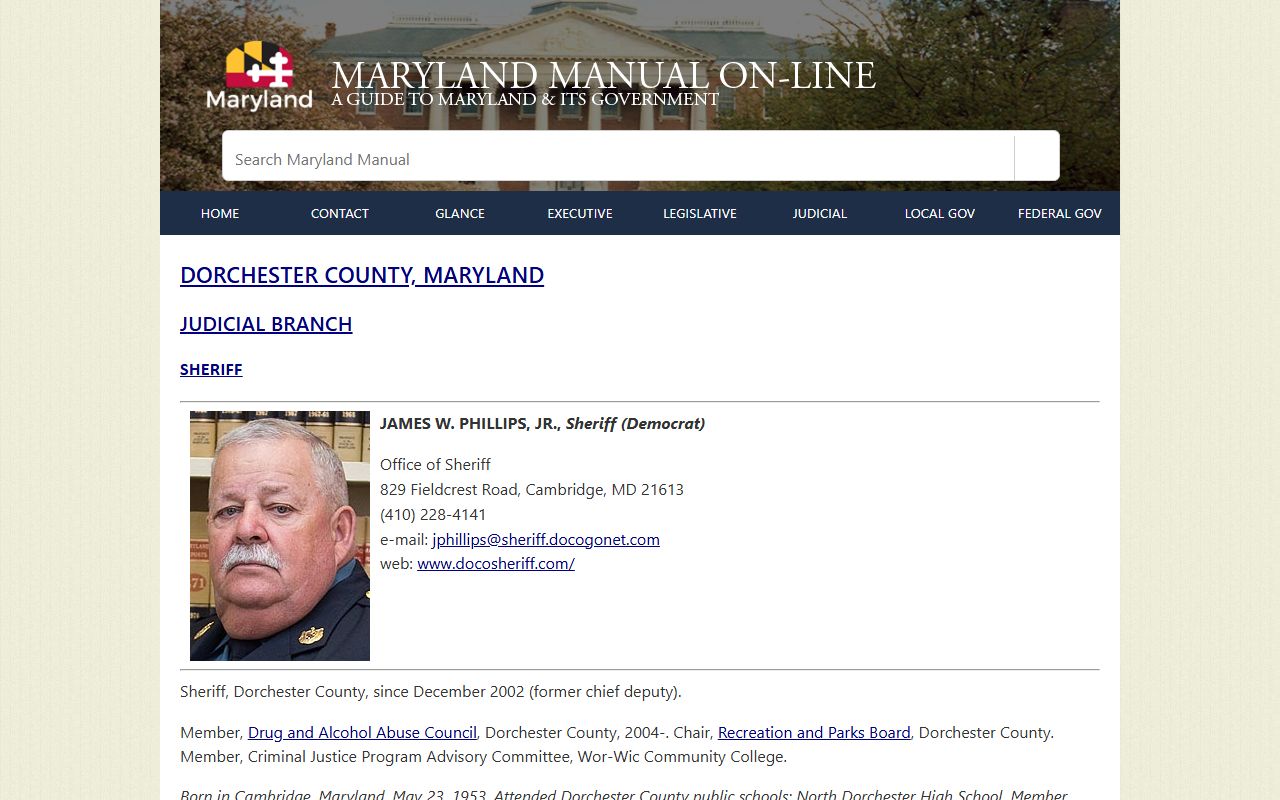
The sheriff source helps identify the law-enforcement office, but charge status still comes from the court record.
Sealed and Expunged Charges
Maryland expungement can remove qualifying arrests, charges, and dispositions from public access. Dorchester expungement starts by identifying the exact case number and disposition, usually through Case Search or the clerk's file. The person uses Maryland Judiciary expungement forms, not a county-made form. Filing goes to the court that handled the case, either District Court at 310 Gay Street or Circuit Court at 206 High Street.
| Sealed | Expunged | |
|---|---|---|
| Public view | Hidden or limited from ordinary inspection. | Removed from public access after a granted court process. |
| Record existence | May remain in court or agency systems under restricted rules. | Covered agencies are directed to remove eligible records from public access. |
| Common trigger | Rule, statute, privacy concern, or court order. | Eligible disposition and a Maryland expungement filing. |
| Research gap | Specific sealing standards were not fully captured. | Exact filing fee and waiting periods by disposition were not confirmed. |
Restricted Dorchester Charge Records
Restricted charge records include juvenile matters, sealed cases, expunged matters, adoption-related records, mental-health materials, and protected personal identifiers. Social Security numbers, financial account numbers, minor information, protected addresses, and health information can be redacted or withheld even when a charge or docket is otherwise public. Ongoing investigations may also affect what is available from law-enforcement sources.
For public charge information, start with the court docket and confirm the custodian. For custody, use sheriff, jail, or VINE channels. For certified court records, contact the clerk. For legal advice, charge interpretation, expungement timing, or defense strategy, use an attorney or the Public Defender process when eligible.
Important: Arrest records and charge records should not be used as proof of guilt or for FCRA-regulated screening.